You've searched "high ticket sales jobs".
You've found four listings, two of which are MLMs and one of which wants you to pay for training before you start.
There's a reason for that.
Where do high-ticket sales jobs actually get advertised?
Most high-ticket sales jobs are never posted publicly. They get filled inside private communities, through founder networks, in Skool and Discord groups, and via placement partners with existing hiring relationships. Public job boards carry a small and unrepresentative slice of the market — mostly the roles nobody in the network wanted.
That single fact changes your entire job search strategy.
Why founders don't post the roles
Put yourself in the founder's chair.
You run a coaching business doing £150k a month. You need one more closer.
Option A: post on Indeed, get 400 applications, 390 of which have never sold anything over Zoom, and spend two weeks screening.
Option B: post in the community where you already hang out, or ring the person who placed your last two closers.
Nobody picks A.
That's the whole mechanic. There's no conspiracy — it's just that hiring through a network is faster and the candidates are better.
The six places roles actually live
1. Skool and Discord communities
Coaching, agency and info-product founders live in these. Roles get posted in a #hiring channel and filled in 48 hours.
Join the communities around the offer type you want to sell, not the ones about being a closer.
2. LinkedIn — but searching for people, not jobs
Don't search "high ticket closer jobs". Search for founders: "coaching", "agency owner", "8-figure", plus your niche.
Look for people posting about scaling, hiring, or their ad spend. Those are companies with call volume.
3. Facebook groups
Still, unglamorously, one of the biggest sources. Remote closing and high-ticket sales groups have daily hiring posts.
Also the highest density of nonsense, so read the scam section below.
4. Placement programmes
Programmes that have actual hiring partners and put people into seats. Ours is BackPack Closers — but the point stands regardless of who you use: judge them on placements, not promises.
5. Job boards — the good ones
Not Indeed. The niche ones. Remote-first boards, and curated lists.
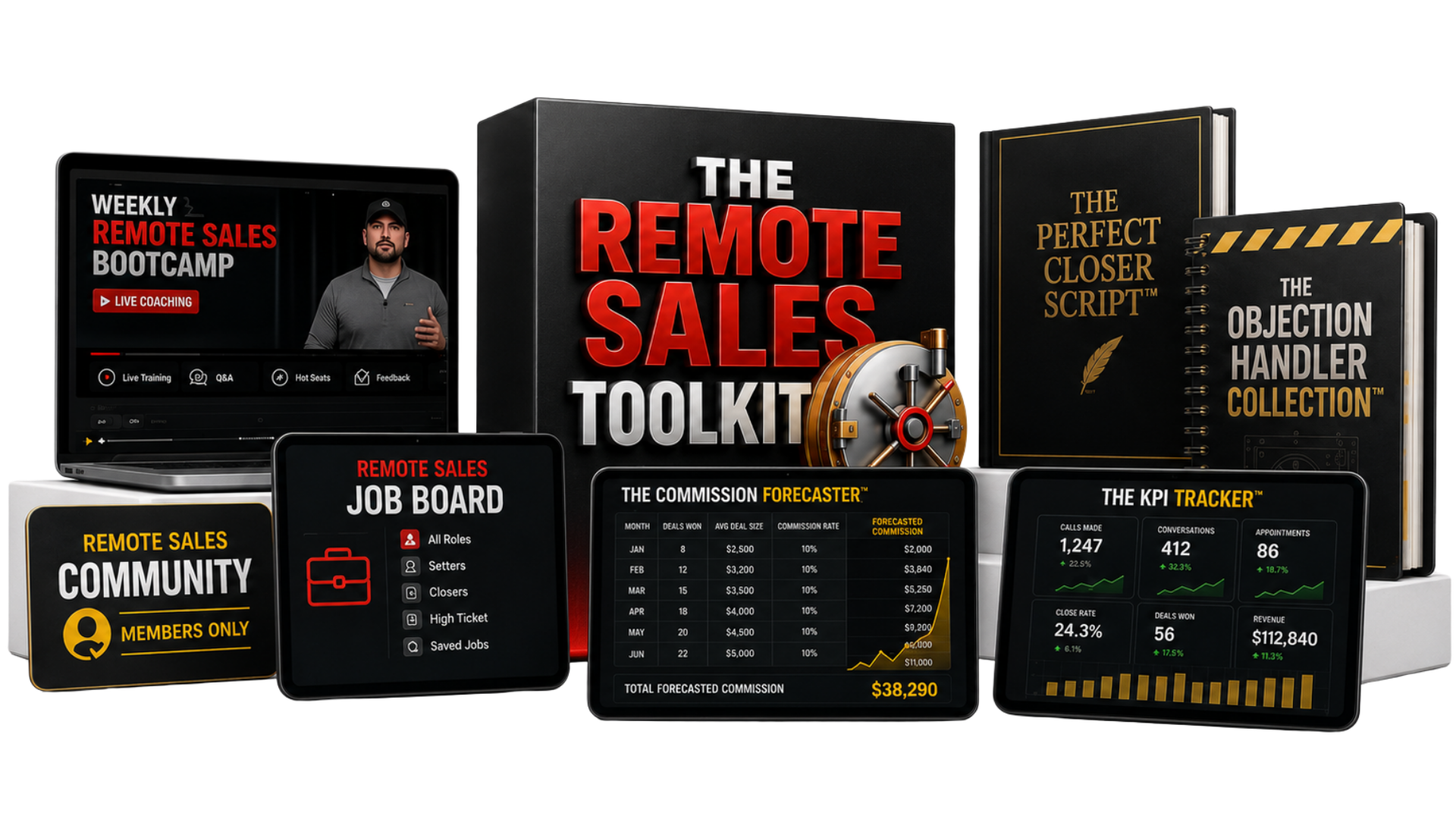
Our free toolkit includes a job board with 180-220 vetted remote sales roles added every month, which exists precisely because the public boards are so thin.
6. Referrals from other closers
The fastest route once you're in. Closers move companies often, and they get asked "know anyone good?" constantly.
Which means your first role's real value isn't the commission — it's the network.
What a legitimate offer looks like
Before you accept anything, you should be able to answer all of these. If the company won't tell you, that's your answer.
| Question | A good sign | A red flag |
|---|---|---|
| Where do leads come from? | Specific: paid ads, setters, organic funnel | "We'll get you leads" |
| How many calls per week? | A real number, with a range | Vague or dodged |
| What's the current close rate? | They know it to a percentage | "Depends on you" |
| What's the offer price? | Clear, single or tiered | Constantly changing |
| Commission percentage? | 10-20%, in writing | "We'll sort it out" |
| Paid on cash collected or contract value? | Stated clearly either way | Never mentioned |
| When does commission pay out? | Weekly, fortnightly or monthly, defined | "When the client pays, eventually" |
| Can I speak to a current closer? | Yes, here's their number | Hard no |
That last one is the killer question. A company with happy closers will connect you in a heartbeat.
The scam checklist
Not everything advertised as a high-ticket sales job is a job.
Walk away if:
- They ask you to pay to be hired. Training you pay for separately is one thing. Paying the employer to start is not a job.
- There are no leads. If you have to generate your own pipeline from scratch on 100% commission, that's not closing, that's unpaid business development.
- The comp is "unlimited earning potential" with no percentage attached. Numbers or nothing.
- The offer itself is dubious. You have to sell it. If you wouldn't buy it, you'll close at 4% and hate yourself.
- It's a recruitment pyramid. If your income depends on recruiting other salespeople, that's MLM with a rebrand.
- They want an upfront "software" or "CRM" fee. No.
One more, subtler one: companies that won't let you review your own call recordings. That usually means they don't record, which means there's no coaching, which means you won't improve.
What roles you can realistically get first
Being blunt about the ladder:
Setter / appointment setter — £1k-£3k offers, booking calls. Lower pay, fastest to get, brilliant for reps. Many closers start here for 60-90 days.
Closer on a lower-ticket offer — £1k-£3k price point. Higher call volume, more forgiving of mistakes, great training ground.
Closer on a mid-ticket offer — £5k-£10k. This is where most placed closers land within their first year.
Senior closer / sales lead — £10k+ offers, or running a team. Two-plus years typically.
Trying to skip to the top with no reps is the most common way people waste six months.
How to apply so you actually get replies
Founders skim. So:
- Lead with a call recording. A 5-minute mock discovery, unedited. It answers the only question they have.
- Two sentences of context. Who you are, what you want to sell.
- Reference their offer specifically. Shows you're not spraying.
- Say what you want. "Looking for a closer seat on a £5k+ offer with inbound leads."
No CV. No cover letter. No "I'm a passionate self-starter."
Everything on interviews — the questions, the roleplay, the traps — is in remote sales interview questions and the Remote Sales Interview Playbook.
Individual results vary and depend on effort, the company you join, and market conditions. No income or employment guarantees are made.
FAQ
Are there entry-level high-ticket sales jobs?
Yes, mostly as appointment setters or closers on lower-priced offers. Very few companies will hand a beginner a £20,000 offer, but plenty will take someone trained and hungry onto a £1,000-£3,000 product where call volume is high.
Do high-ticket sales jobs pay a base salary?
Some do, most don't. A small base or retainer is more common with established companies and agencies. Pure-commission is the norm with founder-led coaching and info businesses. Neither is automatically better — check the lead volume before you judge the structure.
Can I get a high-ticket closer job from outside the UK or US?
Yes. These roles are remote by default and companies hire globally. What matters is your timezone overlap with their lead flow, your English fluency for English-speaking offers, and your internet connection.
How long does it take to land the first role?
For someone training seriously, typically 8-14 weeks from starting to sitting in a seat. Faster with prior sales experience. Much slower if you only apply through public job boards.
Should I take a setter role first?
If you have no sales background, usually yes. Sixty days of setting gets you hundreds of live conversations, teaches you the offer, and often leads to an internal promotion to closer at the same company.