You want to know how to become a high-ticket closer.
Not the fantasy version. The actual version.
So here it is — the same roadmap we walk people through when they book a call with us, minus the small talk.
How do you become a high-ticket closer?
To become a high-ticket closer you learn a repeatable sales framework, record practice reps until your delivery stops being awkward, build a short proof asset that shows you can hold a call, and then apply directly to founders and agencies running paid traffic. Most people who train seriously are interview-ready in 30 to 60 days.
That's the whole thing in one paragraph.
The rest of this page is the detail — because "learn a framework and apply" is technically true and practically useless.
First, understand what you're signing up for
A high-ticket closer takes booked appointments and sells premium offers — usually £4,000 to £25,000 — over Zoom.
No cold calling.
No knocking on doors.
No 400-slide deck.
Somebody else runs the ads. Somebody else books the call. You show up, run a proper conversation, and either the person buys or they don't.
If you want the full breakdown of the role itself, read what a high-ticket remote closer actually is and high-ticket sales explained first. Then come back here.
The trade you're making
You're trading salary certainty for earning ceiling.
Most closer roles are commission-heavy. Some have a small base. Some have none.
That scares a lot of people off, and honestly — good. It should. If you can't stomach a variable month, this is not your career.
But if you can, the maths gets interesting quickly. Which is exactly why we built the calculator.
Step 1 — Run an honest skill audit (Day 1)
Before you learn anything, work out what you're actually starting with.
Score yourself 1 to 5 on each of these:
| Skill | What "5" looks like |
|---|---|
| Listening | You can go 10 minutes without interrupting, and repeat back what someone said |
| Question depth | You ask "why does that matter to you?" instead of moving on |
| Emotional control | Someone gets rude, you don't get defensive |
| Structure | You can run a conversation to a plan instead of vibing |
| Follow-through | You do the boring admin every day without being chased |
Anything under a 3 is your homework list.
Notice what isn't on that table: charisma, being a "natural", having a nice voice, being extroverted. None of it matters. Some of the best closers we've placed are quiet, methodical people who happen to be extremely good at listening.
Step 2 — Learn one framework properly (Week 1)
The biggest mistake beginners make is collecting frameworks.
They watch forty YouTube videos, buy three courses, and end up with a Frankenstein sales process that falls apart under pressure.
Pick one. Learn it until you can run it half asleep.
A working high-ticket call has five phases:
- Frame — set the agenda, get permission, establish who's leading
- Discovery — current situation, what they've tried, what it's costing them
- Gap — make the distance between where they are and where they want to be feel real
- Offer — present the solution against the gap, not as a feature list
- Close — ask, handle whatever comes back, take payment or set the next step
Every good sales methodology is a variation of those five. Learn the phases, not the guru.
The one thing that actually separates good from average
Discovery length.
Average closers spend six minutes on discovery and thirty on pitching.
Good closers flip it.
That's not a personality trait. It's a decision you make on every single call.
Step 3 — Get reps in before anyone pays you (Weeks 2-4)
You cannot learn to close by reading about closing.
You need reps. Here's how to get them without a job:
Record yourself solo. Read a discovery script out loud, on camera, and watch it back. It will be horrifying. That's the point. Do it daily for a week and the horror fades.
Mock call with a partner. Find someone else learning the same thing. Take turns being the prospect. Play difficult — not impossible, difficult.
Review real call recordings. Any decent training programme has libraries of real recorded calls. Watch them with a notepad and mark the exact second the closer takes control.
Roleplay the five worst objections. "It's too expensive." "I need to speak to my partner." "Let me think about it." "I've been burned before." "Can you send me some information?" Write your response to each. Say it out loud fifty times.
Fifty is not an exaggeration. Fifty.
How many reps before you're ready?
Rough rule from what we see: 30 to 40 recorded mock calls before someone stops sounding like they're reciting and starts sounding like they're talking.
At two a day, that's three weeks.
Step 4 — Build the proof asset (Week 4)
Nobody hiring closers cares about your CV.
Genuinely. A founder running £80k a month in ad spend does not want a two-page PDF about your time in retail.
They want to know one thing: can you hold a call?
So give them the answer directly.
- A 5-minute mock call recording — you, running discovery on a fake prospect, unedited
- A 90-second intro video — who you are, why sales, what offer type you want to sell
- One page listing the framework you run and the offers you'd suit
That's it. That's your portfolio.
It beats a CV every time, because it's the actual job.
Step 5 — Apply where the roles actually are (Weeks 4-8)
Here's the part that trips everyone up.
High-ticket closer roles are mostly not on Indeed.
They get filled inside private communities, in Skool groups, in the DMs of people who already know a founder, and through placement teams who have relationships with hiring companies.
We wrote a whole piece on where high-ticket sales jobs actually live — read it, because applying in the wrong places is the single biggest reason people spend six months getting nowhere.
The short version of where to look:
- Skool and Discord communities around coaching, agency and info offers
- LinkedIn — but searching for the founders, not the job posts
- Facebook groups for high-ticket sales and remote closing
- Placement programmes with actual hiring partners
- The job board inside our free toolkit (180-220 vetted remote roles a month)
What to send
Short. Always short.
A founder gets twenty applications a day and reads none of them properly.
Lead with the recording link. Two sentences of context. Done.
Step 6 — Win the interview (Weeks 6-10)
The interview for a closer role is not a normal interview.
It's a test of whether you can sell — run on you, by someone who sells for a living.
Expect to be roleplayed. Expect to be interrupted. Expect them to be slightly difficult on purpose.
We've broken down the actual questions and the frameworks for answering them in remote sales interview questions, and there's a full mock-call framework in the Remote Sales Interview Playbook.
The two things that get people hired more than anything else:
- They ask the interviewer discovery questions. About the offer, the leads, the average call volume, the close rate of the current team. It shows you think like a closer, not a candidate.
- They handle being pushed back on without flinching. That's the whole job.
How long does it actually take?
Honest ranges, based on what we see:
| Starting point | Interview-ready | First role |
|---|---|---|
| Some sales experience, trains hard | 3-5 weeks | 5-9 weeks |
| No sales experience, trains hard | 6-8 weeks | 8-14 weeks |
| Training casually around a full-time job | 3-5 months | 4-7 months |
The variable is almost never talent.
It's reps per week.
People who do two hours a night, five nights a week, move roughly three times faster than people who do two hours on a Sunday.
Individual results vary and depend on effort, the company you join, and market conditions. No income or employment guarantees are made.
The five ways people get this wrong
They course-hop. Three programmes, no reps, no role.
They apply too late. Waiting until they feel "ready" — which never arrives. Start applying around week two. Early interviews are free practice.
They chase the price tag. Trying to jump straight onto a £25k offer with no reps. Take the £3k offer, get 200 calls under your belt, then move up.
They treat it as passive. It's a job. A demanding one. Just one you do from your kitchen.
They skip the boring bit. Follow-up, CRM notes, call reviews. The boring bit is where the money is.
What to do this week
- Do the skill audit above. Write the scores down.
- Pick one framework and stop looking at others.
- Record one mock discovery call today. Today.
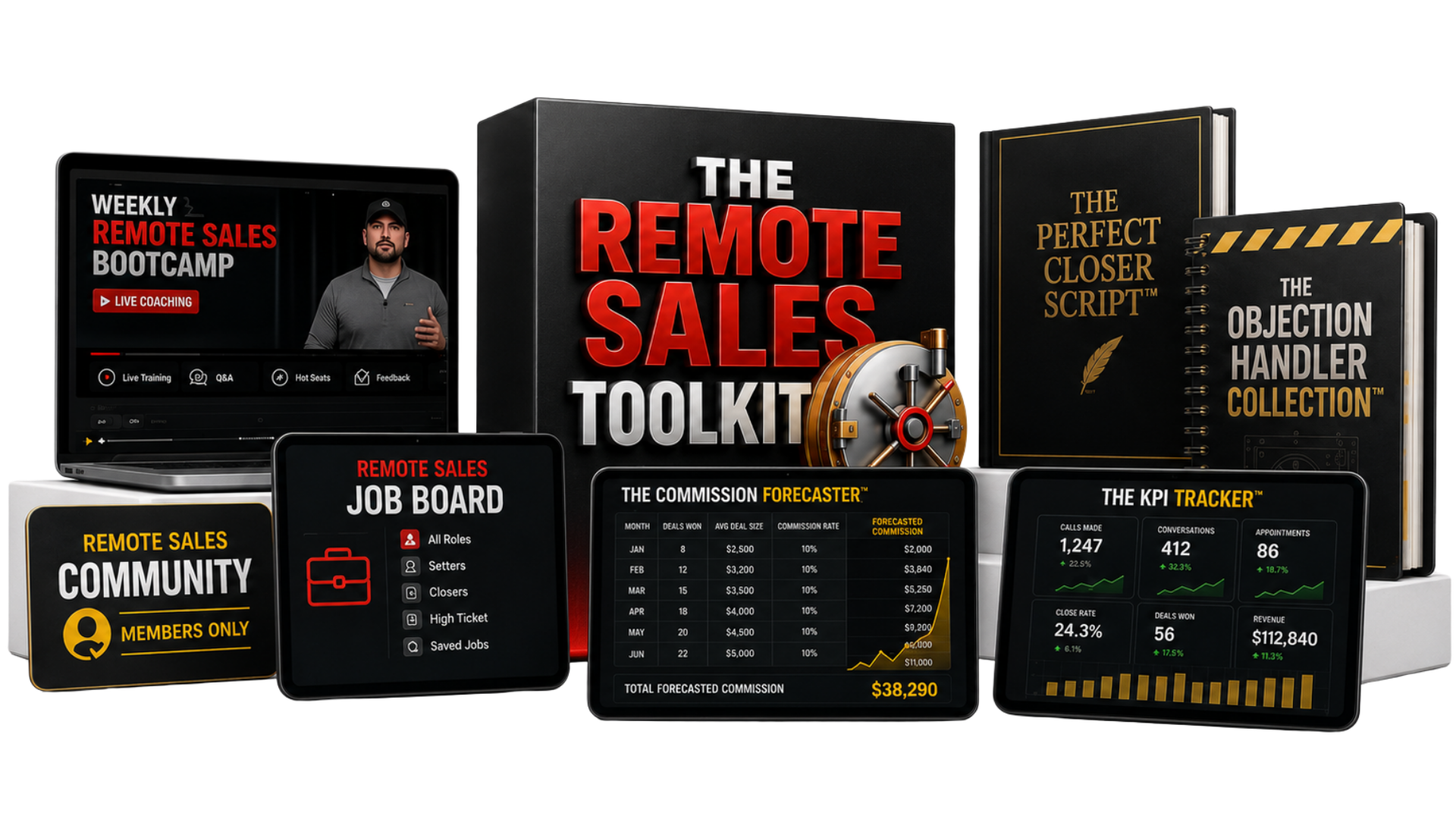
- Grab the toolkit below and use the scripts as your starting framework.
- Book a call with us if you want the compressed version with someone in your corner.
FAQ
Do I need sales experience to become a high-ticket closer?
No. Plenty of the people we place come from hospitality, trades, retail, or no work at all. Prior sales experience helps with nerves, but it also comes with habits that need unlearning. What matters far more is how many recorded reps you're willing to do in your first month.
How much can a high-ticket closer earn?
Pay is typically 10-20% of collected revenue, so earnings depend entirely on offer price, lead quality and your close rate. There is no salary to quote. Run your own numbers on the earnings calculator rather than trusting anyone's screenshot.
Is high-ticket closing a scam?
The role is real and thousands of legitimate companies hire for it. The training industry around it contains plenty of rubbish. Judge any programme on whether it gets people into actual seats, and whether it will show you the placements.
Can I do this part-time?
Yes, to train. Most people learn around a job. The role itself usually needs a consistent daily window, because the calls are booked in advance and no-shows kill your pipeline if you're not there.
What equipment do I need?
A laptop, a stable connection, a headset with a decent mic, and a quiet room with a plain background. That's genuinely the whole list.
Keep going
- High-ticket sales, explained — the economics behind the whole model
- Where high-ticket sales jobs actually are — the hiring map
- Remote sales interview questions — the questions and the answers
- How much a closer actually makes — the honest maths
- Remote Sales 101 — start here if this is all new